How does the budgerigar see?
The budgerigar (Melopsittacus undulatus) is a bird in the order Psittaciformes. Its eyes belong to the vision type UV songbird, parrot and hummingbird: 4 cones with a true UV (UVS) cone and oil droplets, high CFF; UV plumage patterns visible.
Measured in this species: colour, sharpness, night vision and motion (flicker fusion). Measured core: measured values on at least 3 of the 6 dials. Every value below carries its evidence level and sources; nothing is typed by hand.
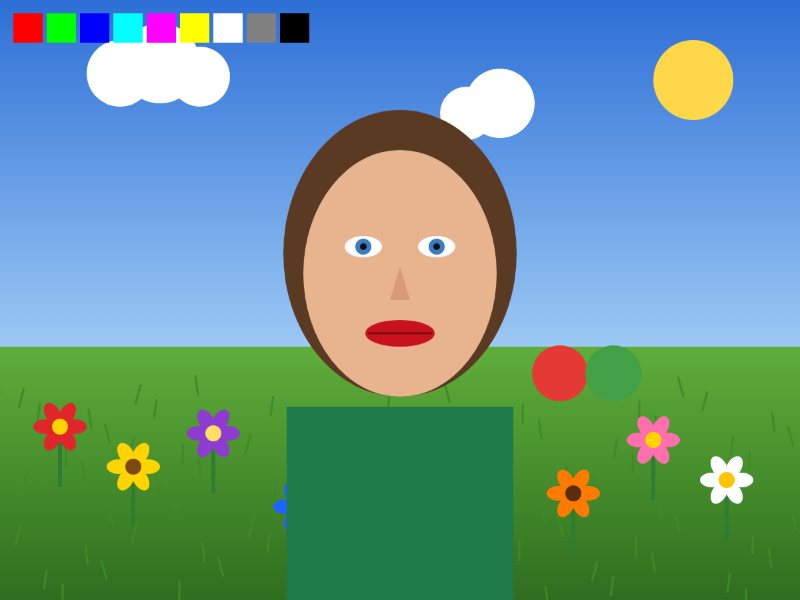
What stands out
- It has 4 colour receptor classes, including ultraviolet; people have 3.
- Its sharpest vision resolves 14.3 cycles per degree: the finest stripe pattern it can tell apart from grey.
- Both eyes see the same 27.5° in front of it (binocular overlap), where depth is judged best.
- It stops seeing flicker at 74.7 Hz, against 60 Hz for people in this dataset, so fast motion looks about 1.2 times slower to it.[22][24]
- Activity pattern: diurnal.
The six dials
Evidence levels: how the tiers work. "Measured" means a value measured in this species; "Estimated" values come from a close relative or an eye-size formula.
| Dial | Value | Evidence | Sources |
|---|---|---|---|
| Colour | Colour receptors 4 receptor classes: 371 nm (UVS), 440 nm (SWS (blue)), 499 nm (MWS (green)), 566 nm (LWS (long)) measured in this species | Measured | [1][2] |
| Ultraviolet yes: at least one receptor peaks in the ultraviolet | Measured | ||
| Sharpness | Acuity 14.3 cycles per degree median of 1 behavioural rows (method priority rule) | Measured | [3] |
| Field of view | Binocular overlap 27.5° median of 133 relatives in class Aves: Accipiter cooperii, Spatula clypeata, Mareca penelope, Anas platyrhynchos, Ardeola ralloides, Baeolophus bicolor | Group default | [4][5][6][7][8][9][10][11][12] |
| Eye placement lateral | Group default | [4][5][6][7][8][9][10][11][12] | |
| Sharp zones (foveas) | Number of foveas 1 median of 48 relatives in class Aves: Branta canadensis, Cardinalis cardinalis, Passerina cyanea, Zenaida macroura, Cyanocitta cristata, Junco hyemalis | Group default | [13][14][15] |
| Fovea type single central fovea (displaced dorso-temporally from retinal centre) | Group default | [13][14][15] | |
| Night vision | Activity pattern diurnal mode of 7 rows (of 7 rows): diurnal; not_nocturnal; photopic | Measured (not re-verified) | [16][17][18][19][2][20][21] |
| Rods vs cones cone-dominated nocturnal -> rod-dominated; crepuscular / cathemeral / mixed -> mixed; diurnal -> cone-dominated | Derived | [16][17][18][19][2][20][21] | |
| Motion (flicker fusion) | Flicker fusion frequency 74.7 Hz median of 3 bright-light rows (behavioural/whole-eye ERG rows; all rows: [69.35, 74.7, 85.0]) | Measured | [22][23] |
Related animals
- Bourke's parrot same vision type
- Crimson rosella same vision type
- Galah same vision type
- Little corella same vision type
- Long-billed corella same vision type
- Red-tailed black cockatoo same vision type
More birds: all birds with measured vision data.
Sources
- Lind O, Mitkus M, Olsson P, Kelber A. 2014. Ultraviolet vision in birds: the importance of transparent eye media. Proc R Soc B 281:20132209. Table 1. doi.org/10.1098/rspb.2013.2209
- Longcore T. 2023. A compendium of photopigment peak sensitivities and visual spectral response curves of terrestrial wildlife to guide design of outdoor nighttime lighting. Basic Appl Ecol 73:40-50. doi:10.1016/j.baae.2023.09.002. doi.org/10.5281/zenodo.8432720
- Caves EM, Fernandez-Juricic E, Kelley LA (2024) Ecological and morphological correlates of visual acuity in birds. J Exp Biol 227(2): jeb246063. Supplementary Table S1.. doi.org/10.1242/jeb.246063
- Cantlay JC, Martin GR, McClelland SC, Potier S, O'Brien MF, Fernandez-Juricic E, Bond AL, Portugal SJ 2023. Binocular vision and foraging in ducks, geese and swans (Anatidae). Proc R Soc B 290: 20231213. ESM full data set (figshare collection 6781097).. doi.org/10.1098/rspb.2023.1213
- Lucas EA, Martin GR, Rocamora G, Portugal SJ. 2024. A seabird's eye view: visual fields of some seabirds (Laridae and Procellariidae) from tropical latitudes. The Science of Nature (Naturwissenschaften) 111. ESM 1.. doi.org/10.1007/s00114-024-01926-4
- Vision and foraging in structurally complex habitats: common moorhens (Gallinula chloropus). Ecology and Evolution 2026, e74060.. doi.org/10.1002/ece3.74060
- Pecsics T, Csorgo T. 2023. Ornis Hungarica 31(2):110-124. doi.org/10.2478/orhu-2023-0023
- Portugal SJ, Ozturk R, Murn CP, Potier S, Martin GR. 2023. Current Biology 33:R1142-R1143. doi.org/10.1016/j.cub.2023.09.016
- Potier S, Duriez O, Cunningham GB, et al. 2018. J Exp Biol 221:jeb177295. doi.org/10.1242/jeb.177295
- Potier S, Roulin A, Martin GR, Portugal SJ, Bonhomme V, Bouchet T, de Romans R, Meyrier E, Kelber A. 2023. Binocular field configuration in owls: the role of foraging ecology. Proc R Soc B 290: 20230664. Data figshare.. doi.org/10.1098/rspb.2023.0664
- Tyrrell LP, Moore BA, Loftis C, Fernandez-Juricic E 2017 (data 2017). The hawk-eyed songbird: retinal morphology, eye shape, and visual fields of an aerial insectivore. Am Nat 189(6). Dryad doi:10.5061/dryad.n7140.. doi.org/10.1086/691404
- Tyrrell LP, Fernandez-Juricic E 2017. Avian binocular vision: it's not just about what birds can see, it's also about what they can't. PLoS ONE 12(3): e0173235. S1 Table.. doi.org/10.1371/journal.pone.0173235
- Moore BA, Tyrrell LP, Pita D, Bininda-Emonds ORP, Fernandez-Juricic E 2017. Does retinal configuration make the head and eyes of foveate birds move? Sci Rep 7: 38406. Appendix 1.. doi.org/10.1038/srep38406
- Potier S, Mitkus M, Bonadonna F, Duriez O, Isard P-F, Dulaurent T, Mentek M, Kelber A 2017. Eye size, fovea, and foraging ecology in accipitriform raptors. Brain Behav Evol 90: 232-242. Supplementary material (Tables S1, S2).. doi.org/10.1159/000479783
- Rodrigues T, Matter MM, Chiodini A, et al. 2026. Foveal vision in fast-flying birds hunting on the wing. bioRxiv 2026.06.05.730304. doi.org/10.64898/2026.06.05.730304
- Anderson SR, Wiens JJ. 2017. Out of the dark: 350 million years of conservatism and evolution in diel activity patterns in vertebrates. Evolution 71:1944-1959. Dryad doi:10.5061/dryad.fg700. doi.org/10.5061/dryad.fg700
- Light conditions and the evolution of the visual system in birds (figshare dataset, SupplementaryDataset1). doi.org/10.6084/m9.figshare.22116371.v3
- Choiniere JN, Neenan JM, Schmitz L, Ford DP, Chapelle KEJ, Balanoff AM, Sipla JS, Georgi JA, Walsh SA, Norell MA, Xu X, Clark JM, Benson RBJ. 2021. Evolution of vision and hearing modalities in theropod dinosaurs. Science 372:610-613. doi:10.1126/science.abe7941. Data: https://osf.io/teq73/. doi.org/10.1126/science.abe7941
- Wilman H, Belmaker J, Simpson J, de la Rosa C, Rivadeneira MM, Jetz W. 2014. EltonTraits 1.0: species-level foraging attributes of the world's birds and mammals. Ecology 95:2027. BirdFuncDat.txt. doi.org/10.6084/m9.figshare.3559887.v1
- Schmitz L, Motani R. 2011. Science 332:705-708, SOM. doi.org/10.1126/science.1200043
- Moura et al. 2024. A phylogeny-informed characterisation of global tetrapod traits addresses data gaps and biases. PLoS Biol 22:e3002658. TetrapodTraits v3.0.1.. doi.org/10.5281/zenodo.22536349
- Healy K, McNally L, Ruxton GD, Cooper N, Jackson AL. 2013. Metabolic rate and body size are linked with perception of temporal information. Animal Behaviour 86:685-696. Table 1. doi.org/10.1016/j.anbehav.2013.06.018
- Lafitte A, Sordello R, Legrand M, Nicolas V, Obein G, Reyjol Y. 2022. A flashing light may not be that flashy: A systematic review on critical fusion frequencies. PLoS ONE 17(12): e0279718. S10 File (CFF database). doi.org/10.1371/journal.pone.0279718
- Inger R, Bennie J, Davies TW, Gaston KJ. 2014. Potential biological and ecological effects of flickering artificial light. PLoS ONE 9(5): e98631. Table 3. doi.org/10.1371/journal.pone.0098631
Every value cites its sources (all sources). Data: catalogue-v1, built 2026-09-29. Accuracy notes: how accurate is this?